What is Bi-Metal Casting?
Co-casting is a relatively new metalworking technique that can create unusual mixed metal pieces. Sometimes referred to as bi-metal casting, co-casting allows two contrasting metals to be cast together into the same piece. Unlike alloys, which mixes two types of metals together, co-casting creates distinctive layers of different metals within the same piece. If you’re curious about the benefits of co-casting, read on to learn more from the experts.
The History of Casting
Humans have been casting metal for centuries, with the oldest cast object, a copper frog, dating back to 3200 BC. This earliest example of casting is attributed to the Mesopotamians.
The ancient Chinese began casting cast iron in 800 BC and developed the first sand molding techniques in 645 BC. Eventually, the metal casting industry was developed during the Industrial Revolution, forever changing manufacturing.
Applications of Co-Casting
While traditional casting uses one type of metal, co-casting allows two types of metals to be used in the same metal piece. Bi-metal casting has many practical applications including tin cans, coins, and jewelry.
Practical Applications
Tin cans are typically made of a bi-metal combination of tin and steel. The outer layer of tin prevents the can from rusting, while the inner layer of steel provides a sterile surface for food. Coins are also often made through bi-metal casting to keep costs down. Like with the American penny, a cheaper metal is covered in a more expensive metal, resulting in a coin that is 95% zinc and 5% copper. Cheaper materials also prevent people from melting down currency to resell for scrap metal.
Besides these functional applications, co-casting can be utilized for its aesthetic properties to create striking mixed-metal jewelry.
Co-Casting in Jewelry
Traditionally, two-toned jewelry is manufactured by casting the two halves in different metals and then soldering the parts together into the final piece. Because multiple metal pieces must be fused together later, these two-tone rings, necklaces, and bracelets must be relatively simple in design, so they can be assembled easily. With co-casting, the metals are cast directly on top of each other, simplifying the process and allowing for much more ambitious jewelry designs.
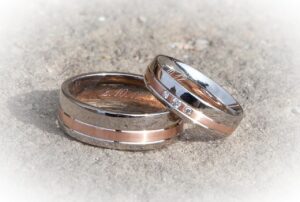
With bi-metal casting, jewelers can create jewelry that features two or more metals in the same piece. One of the most popular combinations is platinum and 18-karat gold. The juxtaposition of warm and cool metals is very unusual and makes for a unique look. Co-casting allows for a never before seen level of complexity that impresses customers.
The Bi-Metal Casting Process
Bi-metal casting a piece of jewelry uses traditional lost wax casting techniques but repeats the casting process two times. First, you must first complete the platinum portion of the design. This entails carving or 3D printing a hard wax model of the first half of the design, creating an investment mold out of plaster, firing the mold in a kiln, using a centrifuge to fill the mold with molten platinum, and breaking the mold away. After the platinum portion is cast, it should be filed and sanded until it is completely finished.
Once the platinum half of the piece is complete, the wax model for the gold portion of the piece is applied directly onto the completed platinum section. If you are designing an intricate bi-metal botanical inspired ring, you might cast the base of the ring out of platinum, polish it until it is complete, and then apply tiny wax leaves to the platinum rings surface, which will be cast into gold during the co-casting process.
Co-Casting Tips
Co-casting opens up a world of possibilities for jewelry designs. With traditional bimetal techniques, undercuts and interlocking designs are extraordinarily difficult, if not impossible to fabricate. Because metal is cast directly onto metal, bi-metal casting allows for a level of complexity that is not possible using metal to metal assembly processes. Casting itself allows for particularly intricate designs. The malleability of wax used for the initial model also allows for incredible detail. Almost anything that can be sculpted from wax, can be cast into metal.
The key to co-casting is the metallurgical bond that is formed when the secondary metal is cast to the primary metal. The bi-metal casting process fuses the two metals together at a granular level, eliminating the need for mechanical assembly.
Choosing Your Metals
The best metals for bi-metal casting are platinum-iridium alloys. Because it does not oxidize, platinum-iridium is an ideal primary metal, and it will not need to be refinished after the secondary 18-karat gold casting. In addition, non-oxidizing platinum is great for co-casting because it is harder than the gold that will be cast on top of it.
Working with Non-Platinum Alloys
While platinum may be the ideal choice for bi-metal casting, you can use other types of metals as long as they meet a series of requirements including:
- The alloys have the ability to easily blend together
- They have low copper content to prevent oxidation
- The alloys don’t have complex characteristics, like age hardening
- The alloys don’t absorb and release a large amount of gas
- They both have a similar expansion coefficient
- The solidus temp of the invested area reaches 50°C to 100°C above the liquidus point o the casting metal
Potential Pitfalls
While co-casting is a versatile technique for fabricating intricate, ambitious jewelry, it is not the best choice for all designs. Bi-metal casting faces the same limitations as traditional lost wax casting. Spindly, wire-like protrusions are extremely difficult to cast, as it is challenging to fill narrow channels in an investment mold. Long thin pieces should be fabricated separately and soldered onto the main piece after it has been cast.
Another thing to note when bimetal casting is the seal between the second wax mold and the platinum base piece. Any air trapped between the primary cast object and the attached wax relief can fill with plaster when an investment mold is made.
If a narrow wall of investment comes between the platinum and the wax, the cast gold will not make contact with the base metal, and they will not fuse together correctly during the casting process. When the piece is released from the plaster mold, the gold and platinum might be in two separate parts, defeating the purpose of co-casting.
Another potential problem with slivers of investment is that when the 18k gold is poured into the mold, the plaster walls often break off. Because a mold is a closed system, the plaster slivers have no way to escape and end up embedded into the molten gold, causing unattractive pits in the final piece.
Working with the Experts
Bi-metal casting is a cool technique that can allow for interesting, detailed, two-toned jewelry. With casting, attention to detail is everything. If you’re interested in creating bi-metal pieces in your collection, work with an experienced jewelry manufacturer to ensure that your pieces come out perfectly.